Showing posts with label Ruth Penfold-Mounce. Show all posts

Thursday, 2 November 2017

Future Sociology – PhD at York (2)


Daniel Robins on Necro-Waste
I am just approaching the end of my first year as a Sociology PhD student here at York. I have two fantastic supervisors: Ruth Penfold-Mounce and David Beer, whom I have been working closely with to develop my project on necro-waste. I did not start with the concept; it just found me about two months in. It affirmed to me that a PhD is always in progress, always amenable to change.
My research focuses on this idea of necro-waste, which is essentially the analogy of corpse parts as waste. By drawing on theories of value, I am exploring the value attached to and generated out of necro-waste as it passes through the UK Death Industry. It’s highlighted at three stages.  The first of these is the gatekeeping stage. This is where the necro-waste is prepared for disposal by the funeral director. Two methods of disposal are then explored; disposal through cremation and disposal through natural burial. This is because these produce two different types of waste; dry waste and wet waste. Each of these offers the opportunity for the necro-waste to be commemorated. As such, the third stage focuses on the artists that reuse cremated remains in these commemorative rituals. This stage also explores what becomes of the natural burial ground.
In the background, I have also been writing through some ideas. I recently published a piece for Discover Society, where I conceptualise Ian Brady’s remains as akin to radioactive waste, otherwise known as ‘toxic necro-waste’. The SATSU department here at York also provides PhD students with a lot of opportunities. I was able to extend these thoughts and write them on the SATSU Threshold blog. Each of these encouraged me to write an article on the Social Epistemology Review and Reply Collective, where I discuss toxic necro-waste further. I understand it as a concept that can be used to further extend the study of necro-waste.
Writing these has helped me as a PhD student in a couple of ways. First, as the PhD is always in progress, it’s helped me to develop some of the ideas in my thesis. Second, it’s provided content, along with my research, to discuss at conferences through both talks and networking with fellow death researchers. Last, it's helped build my confidence as an academic and develop my writing.
I am trying to treat my PhD as an apprenticeship and am actively seeking as many opportunities as I can. I am on the board of studies, and am working with other Sociology PhD students to develop this year’s York Sociology Postgraduate Conference on ‘embodiment’. I also teach two seminar classes on the first year undergraduate module ‘Introducing Social Psychology’, which I really enjoy. So, it’s been a busy, but excellent year.

Friday, 28 October 2016

Rising Crime Porn and violence against women on television

dr ruth penfold mounce 1Ruth Penfold-Mounce has had a busy week with the release of her article with The Conversation on Crime Porn and violence against women on television attracting lots of media attention. She has filmed and recorded with Minster FM, and two Irish radio stations, Today FM and Newstalk Radio.

The article has also been republished in a range of online sites including Scroll.in which has led to a large readership in India. It has been viewed over 14,700 times so far since its publication and is continuing to be a key to public engagement with how much violence is too much.

Wednesday, 12 October 2016

Sexual Violence on Television

Following her appearance on Radio 4 'Body Count Rising' Ruth Penfold-Mounce has been featured on Minster FM relating to the 'crime porn' on television. Ruth spoke about the rise in graphic violence towards women (and men) on television and how often the visual violence could be removed and still leave a compelling story and characters.

dr ruth penfold mounce 1

Follow the link to read, see and hear more: Crime Porn

Tuesday, 4 October 2016

Bodycount Rising on Radio 4

Ruth Penfold-Mounce is speaking on a new Radio 4 programme on thursday 6th October at 11.30am. The programme entitled 'Bodycount Rising' is exploring the rise in female dead bodies displayed on television. Ruth discusses the rise in violence against dead women and challenges the assumption that this is acceptable entertainment. You can catch the programme on iplayer from friday: http://www.bbc.co.uk/programmes/p02pc9qx

The Fall

Friday, 23 September 2016

Ending up in Death Research

Ruth Penfold-Mounce has been published on the up and coming blog Women are Boring. This blog and twitter account is run by Catherine Connolly and Grace McDermott both PhD students at Dublin City University. They seek to disseminate interesting research done by women and to challenge dismissal of women on multiple fronts.

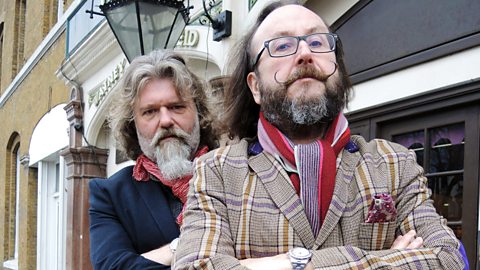
Ruth has written about how she ended up in death research despite being a criminologist in a sociology department. Have a read of Death and Me to see how doing death and crime research led to her meeting the Hairy Bikers.

womenareboring

Wednesday, 24 August 2016

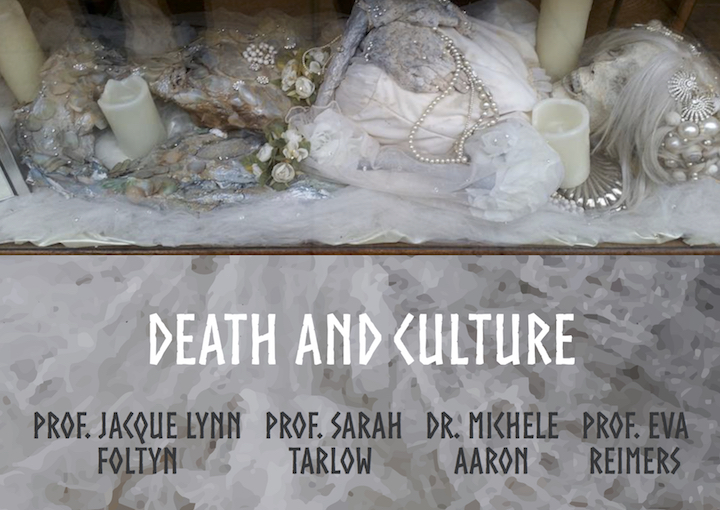
Death and Culture Comes to York

The Death and Culture Conference is next week (1st-3rd Sept).

The badges are made, the programme is being printed and the conference meals have been chosen and ordered.

Its still not too late to register if you want to come.

Tuesday, 26 July 2016

Politicians, Celebrities and Social Media

Nathan Manning and Ruth Penfold-Mounce have had a journal article published in Journal of Youth Studies. The article has been written over the last 2 years and is finally out! 

Ruth Penfold-Mounce
Nathan Manning


See the abstract below:

With electoral politics no longer organised by social class, politicians increasingly seek to relate to a broad spectrum of citizens and part of their relatability is conjured through more casual, informal performances aimed at cultivating authenticity. The various platforms of social media promote forms of authentic communication by blurring the public/private divide, creating ‘spontaneous’ and instant access to ‘real life’. This article seeks to investigate the informalization thesis (Wouters, 2007) by applying it to data from young people aged 16-21 years in Australia, the UK and the USA asked about the way politicians and celebrities use social media. Findings reveal respondents’ desire for more authentic and accessible politicians, but this was in direct tension with traditional views and expectations of politicians needing to be professional, informed and worthy of respect. Informalization amongst politicians is evident and welcomed by young citizens but persistent traditional views means it also threatens their credibility.

The article draws on original data gathered by Brian D. Loader, Ariadne Vromen and Michael Xenos as part of The Civic Network Project (Grant 201300029) funded by the Spencer Foundation.

Making the Difference Award

Ruth Penfold-Mounce, Daryl Martin and Clare Jackson have received the Making the Difference Award. This award is part of the University wide recognition scheme of excellence among its staff. The award was granted on the basis of the Ruth, Daryl and Clare's work as a team on the implementation of the York Pedagogy (YP).


Ruth Penfold-Mounce
Daryl Martin
Clare Jackson

Katy Mann Benn, part of the ProPel team and a member of University Teaching Committee nominated the team on the basis of 'their sheer hard work, commitment and outstanding achievement in ushering in the York Pedagogy.' The University Teaching Committee working group were ‘very impressed by the work and output’ and the Programme Learning Outcomes and Statement of Purpose for one of the programmes was selected to be used on the York Pedagogy website as an exemplar. 


Katy Mann Benn
Katy described working with the YP team as having been a 'consistently productive experience and have been impressed by the collaborative, diligent and thoughtful approach they have consistently demonstrated. Their ability to engage constructively and meaningfully with the review process has been outstanding. I have been particularly impressed by the dedication of the team and the well-organised, conscientious review that they have enabled. Moreover, they have sought feedback from colleagues across the university to inform their plans to enhance the programmes.'

John Robinson
The leadership demonstrated by the YP team has been widely noted including by John Robinson Pro-Vice-Chancellor for Teaching, Learning and Students who said 

I know of the contribution of Clare, Daryl and Ruth indirectly through the reports of the ProPEL team and.... can confirm that it accords with the evidence, and that I judge it to be an excellent appraisal of a team who are making a difference in learning and teaching.’

Many congratulations to Ruth, Daryl and Clare.

Friday, 15 July 2016

Congratulations Class of 2016

On thursday 14th July our Sociology Department Graduands gathered at Central Hall for their Graduation Ceremony. It was certainly a memorable event with too witty and fairly political speeches by the Honourary Doctoral recipients - Dr the Lord Victor Adebowale and Professor Sir Ian Kennedy. Victor talked about wanting to look the future in the eyes and to encourage the graduands to make sure they went to places they shouldn't go and make a difference. Ian meanwhile reflected on the Brexit and the challenges ahead. Nik Brown did a fine job presenting our Sociology students and got most of the names pronounced correctly - its a nerve wracking job!

By the closing of the ceremony our 2016 graduands became graduates and we couldn't be more proud. Congratulations to you all.


Ruth Penfold-Mounce, Wes Lin and Steph Lawler

Wes Lin, Ruth Penfold-Mounce and Nik Brown

Friday, 27 May 2016

BA Criminology ranked 2nd in League Tables

Georgia Ladly, a third year BA Criminology student
The BA Criminology degree has successfully ranked 2nd in the Guardian University League Tables
This is a real achievement for single honours degree run by two departments - Sociology and Social Policy and Social Work. We are just about to see our second cohort of Criminology students graduate in July and its fabulous to see the degree flourishing.

Tuesday, 3 May 2016

Media Impact and the Hairy Bikers


Ruth Penfold-Mounce
Academics are increasingly called to have 'impact' and to be public intellectuals outside of the ivory towers of universities. This often calls for working outside of the comfort zone of many academic researchers - talking to and appearing in the media. Ruth Penfold-Mounce, Lecturer in Criminology reflects on her experience of filming with the BBC:


'Last year in March I received an email from the BBC who wanted to ask some questions about the book I'd written Celebrity Culture and Crime in which I had done a case study of the East End of London 1960s gangster twins, the Krays. Phone conversations followed emails and before I knew it I had been asked to be an 'expert' on the Krays and to walk the Hairy Bikers through a murder scene in The Blind Beggar pub in London. It was an offer I couldn't refuse despite being horribly nervous at the thought of appearing on national television.
The Hairy Bikers' Pubs That Built Britain
The Hairy Bikers
On Friday 29th April 2016 the episode for which I had filmed was shown. Admittedly I was nervous as to how I would come across but after watching it I feel really proud to have done it. Getting out of my comfort zone and appearing on television was a fabulous opportunity to share my passion for celebrity and criminality. I am also glad that I thought in advance about how to make this opportunity into something more than just dissemination of knowledge. I made sure that I got to have a say on the voice over content and I have kept the emails as evidence of my 'impact'.

For fellow academics thinking about how to make the most of media opportunities and to turn it in to impact I would encourage you to consider keeping evidence of how you contributed. Are their suggestions you made that led to a change in emphasis or direction of the debate? If there were phone conversations make sure you send a follow up email confirming what you have suggested - keep the paper trail. We are now (somewhat sadly) in a time where it is vital to think tactically in order to maximize your impact.'

Tuesday, 26 April 2016

Before I Die: A festival for the living about dying

Doctoral Student Anais Duong-Pedica writes about the Before I Die festival:

'This year will mark the 7th national Dying Matters Awareness Week.  This week of events, initially founded by the National Council for Palliative Care, is an opportunity to initiate discussions about death, dying and bereavement at a local and national level. The events put in place aim to change public knowledge, attitudes and behaviours towards death and dying as well as making good deaths more accessible to people.
 Image result for Dying Matters Awareness Week
Dying Matter Awareness Week will take place May 9th-15th in England and Wales. For this occasion, the University of York will contribute to the conversation with its own weekend of events: The Before I Die Festival. The festival takes place on the weekend of May 7th-8th and gathers a dozen of events at York, which focus on death. A few members of the department will be contributing to these discussions. Our very own Ruth Penfold-Mounce will be talking about Celebrity Death and Public Grieving – a topic particularly relevant this year since the recent deaths of Alan Rickman, David Bowie, and more recently, Prince. Meanwhile Celia Kitzinger and Sue Wilkinson will be leading a session on the end of life planning tool - Advance Decisions and  I will be holding a discussion on Dying and Grieving in the Age of Social Media.

Image result for anais duong pedica
Anais Duong-Pedica
In this one-hour session, I wish to start a dialogue on what it means to die and grieve online today. This will be a space where personal experiences will be welcomed and encouraged. We will be exploring different aspects of death and grief, specifically on social media, from the perspective of the individual who is dying/dies, but also from the perspective of close friends, family and acquaintances. I hope to raise awareness of crucial discussions that people ought to have about their death or the death of loved ones and social media: What would I like my account(s) to become? What types of grieving am I comfortable with people doing online? How do social media accounts remind us of the dead and how does that impact our grieving? How do we navigate discomfort with the way other people grieve online? And even, how do we experience grieving for people we only know online?

Not only does the Before I Die Festival play a major role in creating conversations around issues related to death, dying and bereavement and normalising good deaths, it also locates itself within an environment of growing interest for death research. The University of York is home to the Centre for Modern’s Studies’ Death Network and Cemetery Research Group led by Julie Rugg (Department of Social Policy and Social Work). Ruth Penfold-Mounce, Jack Denham and myself (Department of Sociology) also organised a well-attended symposium on Marginal Death Research last October and Ruth Penfold-Mounce, Jack Denham and Julie Rugg will be holding the three-day Death and Culture conference in September this year.  

You can support Dying Matters Awareness Week by sharing the programme on Twitter, visiting the Dying Matters website, and by going along to some of the events.  We also encourage everyone to have “the Big Conversation” – talk with friends and family about your own death and the importance of preparing for it.'


Wednesday, 20 January 2016

Hatton Garden Heist and Crime Capers

Ruth Penfold-Mounce wrote an article for The Conversation on the Hatton Garden Heist which has now been published in the Independent. This jewel, bullion and cash heist is the largest burglary ever in England and has captured the public imagination in its daring and cunning.
Click here

Free workshop on David Bowie's Death

You are invited by Centre for Women's Studies and Sociology to an afternoon of discussion on David Bowie, focusing on personal & media reactions to his death.

David Bowie 'Lazarus' 
Is it a ‘Diana moment’, a distraction from war, floods, January, Cameron?

Is Bowie a genius, recognised in his own time? Is he someone who,as Grayson Perry commented, “sucked up the zeitgeist and gave it to us kids to feast on”.
(11 January, Guardian).

How did his music move us, his style affect us? Which Bowie is your Bowie?

How can we approach seventies ‘baby groupies’ and assess his flirtation with fascism?

Please send ideas for 10 minute discussion-starters by 20th January to:  ann.kaloski-naylor@york.ac.uk & ruth.penfold-mounce@york.ac.uk 

Date: 3rd February, 1.30-4, VX330, 3rd floor, Grimston House (by Market Square). FREE EVENT, tea & coffee from 1.15.

Narratives of Hope: Science, Theology and Environmental Public Policy (SATSU)

Date and time: Wednesday 10 April 2019, 1pm to 2pm Location: W/306, Wentworth College, Campus West, University of York ( Map ) Audie...